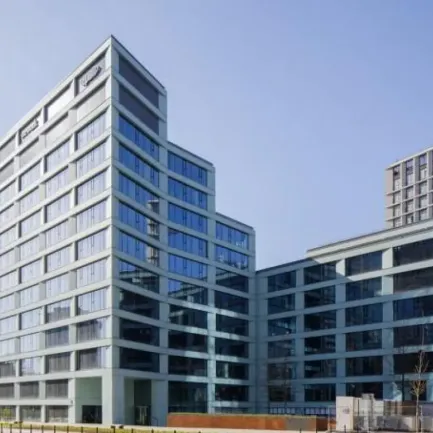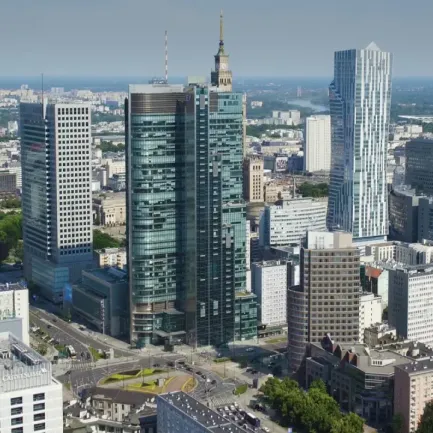

Competition for the city’s best-in-class offices is in full swing among companies whose lease agreements are set to expire over the next few years. However, not all tenants will be able to secure space meeting their expectations. Office availability in central Warsaw and the adjacent Wola district is shrinking rapidly; success now depends on a tenant’s ability to balance market realities with their long-term business requirements.
Many companies have been postponing lease decisions in anticipation of greater office availability, more favourable market conditions or a correction in rental rates. Today, however, the likelihood of such a scenario materialising is becoming increasingly remote. With the supply of modern space remaining constrained, the pipeline of planned office projects at a record low and the availability of large, premium-quality office units continuing to shrink, the wait-and-see strategy appears less viable than ever. Rather than delivering anticipated savings, it is more likely to result in higher costs and a more limited range of options.
The decision-making window is closing fast
“The availability of Class A office space in Warsaw is declining, particularly in the city centre and in the adjacent Wola district, where companies are most eager to expand. This situation is further exacerbated by limited new supply. By the end of the first quarter, development activity in the Polish capital had fallen to its lowest level since 2011. Just over 115,000 sqm was under construction, with only one project – AFI Tower – having broken ground over the past 12 months,” says Magdalena Zagórska, Director, Office Department, Newmark Polska.
Notably, a significant proportion of office projects are almost fully pre-let before completion. Meanwhile, over a dozen large companies whose lease agreements are due to expire between 2028 and 2030 are already actively searching for new premises, with their requirements estimated at 250,000 sqm. As a result, competition for prime office space is intensifying and the market is becoming increasingly landlord-friendly. Vacancy in modern, centrally located office buildings remains low at approximately 6%, naturally putting upward pressure on rents.
According to Magdalena Zagórska, the market situation would not change materially even if developers were to restart projects today: “Depending on the size and complexity of a scheme, it takes between two and three and a half years to deliver a new office building. Even if new projects are launched right now, supply is unlikely to improve significantly before the end of this decade. Meanwhile, companies planning to relocate or renegotiate their leases by 2030 cannot afford to delay their decisions.”
Renegotiate or relocate? Time is running out for tenants
In recent years, many organisations have reassessed their workplace models and office space requirements. Now that most companies have completed this process, starting the search for new office space early and developing a leasing strategy have become increasingly important.
“The optimal moment to start preparations is three to four years before lease expiry. This period is needed to engage an advisor, conduct a workplace study, analyse available options, and negotiate and sign a lease agreement. This is followed by the office design and fit-out phase, which is a lengthy process that can take anywhere from several months to more than a year, depending on the scale of the project,” explains Magdalena Zagórska. “If you begin the process less than a year before your current lease expires, you will often have little choice but to remain in your existing location, regardless of whether it is optimal for your business or not.”
The expert notes that companies could significantly broaden their range of options by taking a wider view of the market rather than focusing exclusively on central locations. Areas that could regain popularity as alternatives include Mokotów and, in particular, Służewiec, where monthly rents currently range from approximately EUR 12.00 to EUR 16.00 per square metre. While these locations do not offer the same level of connectivity or prestige as the rapidly expanding city centre or the adjacent Wola district, their clear cost advantages are becoming a key factor in occupiers’ decision-making as pressure to optimise spending remains strong.
According to Newmark Polska advisors, developing alternative scenarios strengthens a tenant’s negotiating position. Companies that start the process early enough can simultaneously renegotiate the terms of their existing lease while exploring alternative options available on the market. Another solution is to secure space in projects under construction. “A third option, sometimes chosen by large organisations, is to extend their current lease temporarily, giving them additional time to select their final location,” says Magdalena Zagórska. She emphasises that each of these strategies requires advance planning, as the range of available options continues to narrow with each passing quarter.
The office must be ready for change as it unfolds
However, despite mounting market pressures, companies should not make decisions based solely on space availability or rental rates.
“Today, it’s impossible to manage the workplace effectively – including making decisions about relocation or lease renegotiation – as if the world had not changed. We are living through a period of constant transformation – from the large-scale trial of remote working and the subsequent mandatory return to the office to the accelerated adoption of artificial intelligence. What was considered a trend just a few years ago is now becoming a new reality. This shift directly impacts office decisions – not only in terms of how much space companies need, but, above all, the role of the office in their organisations,” says Edyta Mika, Director, Workplace Strategy Change Management, Newmark Polska.
Just as the hybrid work model evolved from an experiment into a force that reshaped the office market, artificial intelligence is now following a similar trajectory. “In addition to technological disruption, demographic shifts are also having a strong impact on workplace models. Research clearly indicates that the pool of talent entering the labour market is shrinking, while the overall workforce is ageing. Together, these forces are driving not only process automation but also the need to create workplaces that are attractive in terms of their physical environment and technological capabilities. That’s why designing a new office cannot simply be a matter of replicating past solutions,” says Edyta Mika.
Flexibility and mobility – understood not only as the ability to scale office space up or down, but also to adjust the role of the office to the evolving needs of an organisation – are among the characteristics of future-proof offices. The workplace should offer a variety of settings optimised for focused work, collaboration and meetings, while allowing for their proportions to be adjusted without costly reconfigurations of the entire space. A well-designed office should support the seamless reorganisation of individual areas while maintaining a consistent look and feel of the workplace. Space must be designed with the expectation that an organisation may operate under completely different conditions in just a few years’ time.
“Assessing the implications of these changes for tenants regarding the function and size of the office requires in-depth qualitative and quantitative research. Such research must be carried out using a proven methodology and through dialogue with all stakeholders,” adds Mika.
An office is more than just square metres
According to Edyta Mika, today’s office should be designed not solely around desk counts but around the specific functions that support an organisation’s objectives. “For many years, companies viewed new office decisions primarily through the lens of space and cost considerations. However, this is an oversimplification. Optimisation does not always mean reducing physical footprints. In some cases, it means using space more effectively, rebalancing proportions, or adding new features that enhance employee productivity in their new workplace,” she explains.
Automatically reducing office space based solely on the number of employees working hybrid schedules is a particularly risky strategy. “Many tenants still assume that office space can be reduced simply by taking into account the number of employees working remotely or in a hybrid model and calculating workstation requirements accordingly. But that’s not how it works in practice. Recent experience has shown that a traditional desk is not the only workplace setting. To operate effectively, we need a diverse range of spaces: areas for focused work, collaborative zones, project rooms, ad hoc meeting areas, conference rooms for meetings of varying levels of formality, as well as well-equipped facilities for online meetings. Equally important are spaces that encourage social interaction, team integration and employee wellbeing. The type of space an organisation requires should be determined by clearly defined office functions and space budgets, rather than by the number of traditional workstations alone,” says Mika.
Don’t waste time – use it to gather data
The Newmark Polska experts emphasise that companies should not expect market conditions to return to what they were several years ago anytime soon. However, this does not mean that occupiers should rush into decisions.
As the wait-and-see approach is no longer a viable strategy, companies should use this time to gather data and gain a deeper understanding of their organisational needs. This process may involve redefining the workplace model and, by extension, reassessing functional requirements and space budgets for new or reorganised offices. This is no easy task at a time when market conditions are forcing organisations to make decisions about future office space much earlier than past relocation or lease renegotiation cycles would suggest. Companies must anticipate a rapidly changing future while mitigating risks.
The answer to this market uncertainty lies in in-depth analysis and workplace studies. “Guesswork has no place in effective consultancy. In a highly volatile environment, organisations cannot simply replicate solutions from their previous offices or base decisions solely on experiences from several years ago. The sooner an organisation begins analysing its needs, the greater the likelihood of creating a workplace that will support its business objectives in the future,” says Edyta Mika.
Magdalena Zagórska notes that only a combination of market expertise and a thorough analysis of corporate needs enables companies to make informed decisions about their future office footprints. “Organisations that begin preparations early will have a distinct competitive advantage. With limited supply and intensifying competition for premium space, time has become one of the most valuable assets available to tenants. That’s why delaying decisions is no longer advisable,” she adds.