
With its large scale, stable demand and experienced workforce, Upper Silesia is one of the most predictable commercial property markets in Poland. Offices and warehouses operate there as part of a single ecosystem, supporting manufacturers, logistics operators and service providers, say Jakub Kurek and Tomasz Chojnacki from Newmark Polska.
Once associated primarily with heavy industry, the region has undergone a deep transformation in recent years, emerging as one of Poland’s major hubs for logistics and business service centres. This shift has particularly benefited Katowice. Located at the intersection of key north-south and east-west transport corridors, the city plays a central role within the Silesian Agglomeration.
“The region’s growth is being driven by rail infrastructure investments, including the redevelopment of the Katowice hub, and the construction of a new tramline serving the southern part of the city, scheduled for 2026,” says Magdalena Kolka, Deputy Director at Investors Assistance Department at Katowice City Hall. The transport infrastructure is complemented by Katowice Airport, Poland’s largest regional cargo airport and a national leader in charter flights. The airport handled a record 7.3 million passengers in 2025 and is expected to see approximately PLN 1.8 billion in infrastructure investments in 2024-2032.
Warehouses at the heart of the economy
The warehouse market is one of the key pillars of the regional economy. With nearly 6.2 million sqm of modern warehouse space, representing 16.9 per cent of national stock, Silesia has become Poland’s second-largest warehouse hub after Warsaw. “Upper Silesia, which forms a dense conurbation of more than ten large cities, offers extensive opportunities to locate warehouse and logistics facilities close to manufacturing plants, end consumers and transport hubs. This makes the market more stable and resilient to fluctuations,” explains Jakub Kurek, Head of Industrial and Warehouse, Newmark Polska.
The region boasts a relatively low vacancy rate of just over 8 per cent, with nearly 192,000 sqm under construction – well below take-up, which surpassed 1 million sqm in 2025. Analysis of take-up reveals that Silesia remains strongly linked to industry and logistics operators supporting manufacturers. Demand was driven primarily by companies from sectors such as 3PL (24 per cent), engineering and construction (19 per cent) and automotive (14 per cent).
On the supply side, the market is dominated by leading developers. Since 2020, more than one-third of new production and warehouse space in Upper Silesia has been delivered by Panattoni, followed by 7R and Hillwood Polska. “Urban locations are gaining in importance, with Class A warehouses operating in the immediate vicinity of other buildings, some serving quite unusual functions – for example, as sports facilities. These examples show how flexible such space can be,” says Jakub Kurek. According to Newmark Polska analysts, the region still has substantial land available, with some projects designed for phased expansion. Notable examples include CTPark Zabrze, Panattoni Park Katowice Airport, and Prologis Park Ruda Śląska.
The marriage of office and warehouse
The warehouse and office markets in Silesia are increasingly converging. “Most warehouses now include offices ranging from several hundred to about a thousand square metres, enabling companies to manage operations from a single location – more economically and closer to their processes. At the same time, some tenants – especially those with a stronger corporate profile – continue to prefer traditional office buildings in city centres,” comments Kurek.
For some manufacturing and logistics companies, the natural next step after locating plants and warehouses in the region is to move their operational headquarters and central offices to Katowice. “Companies are increasingly choosing to locate their offices here, which allows them to concentrate key functions within a single region and streamline management processes,” says Tomasz Chojnacki, Regional Director, Office Department, Newmark Polska. “Katowice specialises in supporting supply chain processes, as evidenced by service centres operated by brands such as Unilever, Lipton, and Danone. The city is also home to companies combining office and engineering functions, such as L3Harris Technologies, with competitive office rents of EUR 13–16 per square metre providing an additional advantage.”
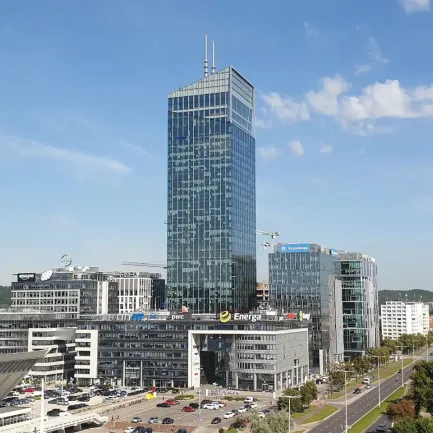
Katowice is the first choice for companies seeking an office in Silesia. This has led to significant consolidation of offices from neighbouring cities in recent years. This trend is illustrated by Vattenfall’s decision to consolidate its Gliwice and Katowice offices. Smaller markets, such as Gliwice, now play a complementary role and have become more specialised. “In Gliwice, this shift is particularly visible in the IT sector, supported by the academic base of the Silesian University of Technology, the presence of large industrial plants and the operation of the Special Economic Zone,” explains Tomasz Chojnacki.
According to the expert, the growth of the Katowice office market is also being driven by good transport accessibility, as well as the ongoing large-scale rail project intended to improve also regional rail connections, which are crucial in a conurbation with a fragmented structure. Another significant factor is the concentration of office projects along the east-west axis, in the vicinity of the Central Highway and Chorzowska Street. Another advantage is the availability of development land, which remains significantly higher than in more densely built-up regional towns.
Tenants can choose not only modern office buildings but also mixed-use developments delivered as part of the revitalisation of post-industrial sites. “A good example is Nowy Wełnowiec, which is being developed on the vast site of a former zinc smelter and combines residential, service and office uses. Similar projects are underway in the city centre, including near Dworcowa Street, where entire urban areas are being revitalised for hotel and office use,” says Tomasz Chojnacki. The expert notes that Katowice is consistently unlocking its spatial and investment potential, strengthening its modern identity and laying solid foundations for further growth.
A skills-based market
The growth of Katowice and the Silesian Agglomeration goes hand in hand with rising demand for skilled labour. Both technical skills and readiness to work in a digitalised environment are sought after. “In logistics, demand is growing for operators of automated systems, robotics programmers and maintenance specialists, as well as IT professionals specialising in systems such as WMS, WCS and MES. At the same time, attracting and retaining both skilled and non-skilled blue-collar workers – including warehouse operatives, forklift operators and production staff – remains a challenge,” says Natalia Nijak, Division Manager, Grafton Recruitment.
The business services sector, which employs more than 36,000 people in the Silesian Agglomeration, remains a major employer. In recent years, it has evolved towards centres of competence and specialised processes. “Analytical skills and proficiency in workflow automation tools are in demand across offices,” says Natalia Nijak. The market benefits from a strong educational base: the Silesian University of Technology, the Silesian University, the University of Economics and more than a dozen other higher education institutions. According to the expert from Grafton Recruitment, vocational education also plays an important role in industrial regions such as Silesia, providing a pool of workers with practical skills that help ensure operational continuity and enhance efficiency.
The Silesian labour market is further strengthened through close cooperation between the city and business. “We support the Corporate Readiness Certificate programme, which was launched in Katowice in 2013 and is currently delivered in partnership with Accenture, ING Hubs Poland, and Kyndryl. It prepares students and graduates to enter the job market. Secondary school students participate in initiatives such as Kyndryl Future Achievers and Fujitsu-Tech, acquiring practical technological skills. This year, we have launched the Technological Career Compass – a joint project with Sopra Steria. Additionally, the Katowice Gaming and Technology Hub, currently under development, will use post-industrial sites to bring education, innovation and business together in one location,” explains Magdalena Kolka, Katowice City Hall.
Silesia on its journey to the future
The region has all the assets needed to support the development of logistics, industry and services in the years ahead, while attracting new investment and skilled labour.
“Silesia benefits not only from its location and infrastructure but also from its skills base and market maturity, allowing companies to plan investments over the long term,” concludes Jakub Kurek from Newmark Polska. Meanwhile, Tomasz Chojnacki adds that the future growth of the office market will be driven primarily by revitalisation projects, the availability of attractive development land and the increasing scale of new developments. In his view, the combination of industrial and logistics facilities, modern offices and professional market advisory services makes Silesia one of the most promising commercial property markets in Poland.
In the photo, from the left: Jakub Kurek, Head of Industrial and Warehouse, Newmark Polska; Tomasz Chojnacki, Regional Director, Office Department, Newmark Polska; Magdalena Kolka, Deputy Director at Investors Assistance Department at Katowice City Hall; Natalia Nijak, Division Manager, Grafton Recruitment